Devixa Devixa

Top China Industrial AI Server Manufacturer for Global Buyers?

Time:2026-10-16 Author:Isabella
0%

Choosing the top China industrial AI server manufacturer requires more than comparing processor models or advertised prices. Global buyers need evidence of practical engineering, stable production, and responsible after-sales support. A capable supplier should explain how its systems handle dust, vibration, heat, and continuous workloads. These details matter in factories, transport hubs, energy sites, and remote inspection stations.

An experienced industrial ai server manufacturer can provide configuration guidance for GPUs, CPUs, memory, storage, and network expansion. It should also discuss thermal design with measurable information, such as airflow direction, fan control, operating temperature, and maintenance access. Product testing deserves close attention. Buyers may request burn-in records, component traceability, quality procedures, and compliance documentation for their destination markets. Clear warranty terms and spare-parts planning also reveal operational maturity.

However, no manufacturer is perfect. Public specifications may not show failure rates, repair delays, or real performance under mixed industrial loads. That gap deserves careful questioning. A reliable evaluation should include sample testing, reference checks, factory communication, and written acceptance standards. Experience often appears in small details: labeled cables, replaceable filters, protected ports, and packaging that survives long-distance transport. Technical authority should be supported by engineers, not only sales language. Global buyers can then compare Chinese suppliers with greater confidence, while recognizing that the lowest quotation may create hidden integration costs. The right choice combines performance, documentation, service responsiveness, and honest discussion of limitations. That balance supports dependable AI deployment.
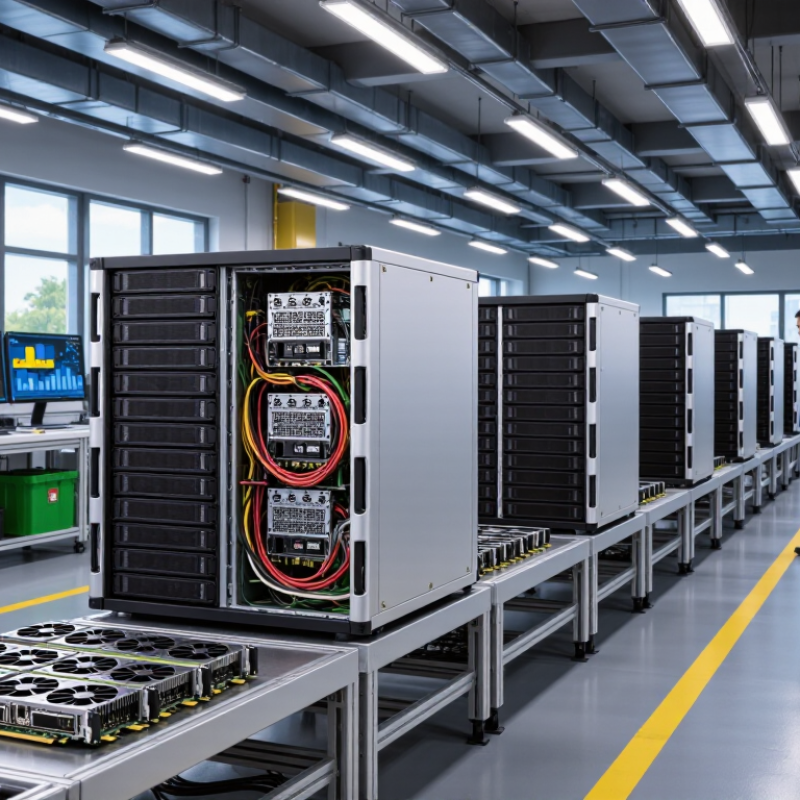
Top China Industrial AI Server Manufacturer for Global Buyers?

Definition and Role of Industrial AI Server Manufacturers

Top China Industrial AI Server Manufacturer for Global Buyers?

An industrial AI server manufacturer designs computing systems for demanding factory environments. Unlike a general data center supplier, it considers dust, vibration, heat, and continuous operation. Its servers may process camera images, sensor signals, and robotic instructions near production lines. This reduces delays caused by sending every decision to a distant cloud. The role is practical, not merely technical.

A capable manufacturer selects processors, accelerators, storage, and cooling systems for specific workloads. It also validates thermal performance under sustained pressure. In a workshop, this may involve running inspection models beside a conveyor for several days. Engineers check response time, power use, network stability, and recovery after an unexpected restart. Small details matter. A loose connector can stop a whole shift.

Reliability also depends on documentation and honest communication. Global buyers should request test records, component traceability, firmware update policies, and regional compliance evidence. Technical support should explain replacement procedures, warranty limits, and cybersecurity responsibilities clearly. Experienced manufacturers often provide sample deployment plans before full production. This reveals weak assumptions early. No design is perfect. A server that performs well in a laboratory may struggle beside a hot stamping machine. Careful manufacturers admit that risk, measure it, and improve the design through field feedback. Their value lies in turning industrial data into stable, maintainable decisions.

Core Technologies Behind China’s Industrial AI Servers

Industrial AI servers built in China increasingly serve factories, energy sites, logistics centers, and research facilities worldwide. Their value depends on engineering depth, not only processor speed. In practical deployments, engineers combine multi-core CPUs, AI accelerators, high-speed memory, and NVMe storage for rapid model inference. This architecture can inspect metal surfaces, predict motor failures, and analyze video streams near the production line.

Thermal management is equally important. Industrial enclosures often face dust, vibration, and uneven airflow. Engineers use redundant fans, heat pipes, liquid cooling options, and temperature monitoring to protect performance. Error-correcting memory helps reduce silent data corruption. Industrial network interfaces also support low-latency communication between servers, sensors, cameras, and control systems. Edge computing keeps sensitive data closer to its source. It can also reduce delays when factory connectivity becomes unstable.

Reliable platforms require more than powerful hardware. Secure boot, firmware verification, access control, and encrypted storage strengthen system protection. Remote monitoring helps maintenance teams review temperatures, disk health, and accelerator usage without entering restricted areas. In field testing, however, ideal laboratory results do not always match factory conditions. Cable placement, dust buildup, and outdated software can still weaken performance. That is why experienced teams validate systems under heat, vibration, workload spikes, and long operating cycles. Modular components make repairs easier, but they can increase integration complexity. Careful documentation remains essential.

Core Technologies Behind China’s Industrial AI Servers

Nominal one-way bandwidth comparison of key server technologies used in industrial AI infrastructure. Values are based on published interface and memory specifications: PCIe 5.0 x16 is approximately 503 Gb/s after 128b/130b encoding, 400GbE provides 400 Gb/s, DDR5-4800 provides 307 Gb/s per 64-bit memory channel, and PCIe 4.0 x4 provides approximately 63 Gb/s after encoding. Actual application performance depends on topology, software, workload, and thermal conditions.

Key Product Types and Industrial Use Cases

Top China Industrial AI Server Manufacturer for Global Buyers?

Industrial AI servers are no longer limited to large data centers. Buyers typically choose three product types: rugged edge servers, GPU-accelerated rack servers, and compact inference systems. Edge models process camera feeds beside production lines. Rack systems train models and support digital twins. Compact inference units deliver fast decisions for robots, inspection stations, and warehouse equipment.

The use cases are practical. A steel plant may inspect surface cracks under uneven lighting. A food factory can detect package errors before sealing. Predictive maintenance systems analyze vibration, temperature, and motor current. IDC’s Worldwide AI and Generative AI Spending Guide projects global AI spending to reach about 632 billion dollars by 2028. That growth strengthens demand for scalable industrial computing. However, raw processing speed is not enough.

The International Energy Agency reports that data centers used about 415 terawatt-hours of electricity in 2024. Industrial buyers should therefore examine performance per watt, cooling design, and remote maintenance. Dust filters, wide-temperature operation, and redundant storage matter on real factory floors. A specification can still fail.

In my experience, deployment problems often come from network delays, poor camera placement, or incomplete training data. Industrial servers need manageable software, secure update processes, and clear lifecycle support. Buyers should test workloads using actual images, sensor streams, and shift patterns. The final choice may be less powerful, but more dependable.

Top China Industrial AI Server Manufacturer for Global Buyers? - Key Product Types and Industrial Use Cases
Industrial AI Server Type Typical Hardware Configuration Primary AI Workloads Industrial Use Cases Deployment Environment Key Selection Metrics
GPU Training and Inference Server 2–8 accelerator cards; dual server processors; 256 GB–2 TB ECC memory; NVMe SSD storage; high-speed Ethernet or InfiniBand networking. Deep-learning model training, large-scale computer vision, predictive maintenance, digital-twin simulation, and generative AI inference. Smart Manufacturing Energy Transportation Research Data centers, centralized industrial AI platforms, and private-cloud environments. Accelerator memory, FP16/FP8 performance, PCIe or fabric bandwidth, power capacity, thermal design, and rack density.
Rack-Mount Inference Server 1–4 accelerator cards or integrated AI accelerators; 64–512 GB ECC memory; redundant power supplies; multiple 10/25/100 GbE ports. Real-time image classification, object detection, anomaly detection, optical character recognition, and production-line analytics. Quality Inspection Robotics Warehouse Automation Factory server rooms, industrial data centers, and near-line processing zones. Inference latency, images or video streams per second, accelerator compatibility, redundant power, remote management, and operating cost.
Industrial Edge AI Server Compact 1U, 2U, or short-depth chassis; 32–256 GB ECC memory; solid state storage; optional discrete or integrated AI accelerator. Low-latency inference, sensor fusion, machine monitoring, local data filtering, and offline AI decision support. Process Control Mining Oil and Gas Utilities Factory floors, substations, remote sites, control rooms, and industrial cabinets. Operating temperature, vibration resistance, ingress protection, fanless or filtered cooling, boot reliability, and network redundancy.
Rugged Edge Computing Server Reinforced chassis; ECC memory; industrial solid state drives; DC-input or wide-range power options; serial, CAN, Ethernet, and digital I/O interfaces. Autonomous inspection, predictive maintenance, equipment diagnostics, geospatial analytics, and condition-based monitoring. Railways Ports Mining Vehicles Defense Infrastructure Mobile platforms, outdoor enclosures, vehicles, tunnels, and locations with unstable connectivity. Shock and vibration tolerance, temperature range, dust protection, DC power input, serviceability, and long-term component availability.
AI Storage and Data-Ingestion Server High-capacity HDD and NVMe tiers; 128–512 GB ECC memory; RAID or erasure coding; 10/25/40/100 GbE connectivity; optional AI accelerator. Video archiving, sensor-data aggregation, dataset preparation, feature extraction, and high-throughput model training pipelines. Video Surveillance Smart Cities Industrial IoT Healthcare Imaging Central data centers, private clouds, and distributed industrial storage clusters. Usable capacity, sequential and random I/O, data-protection method, network throughput, retention period, and expansion capability.
Digital-Twin and Simulation Server Multi-core server processors; 256 GB–2 TB ECC memory; high-memory accelerators; fast NVMe scratch storage; high-speed cluster interconnect. Computational fluid dynamics, finite-element analysis, factory-flow simulation, 3D visualization, and physics-informed machine learning. Automotive Aerospace Construction Heavy Industry Engineering data centers, high-performance computing clusters, and product-development laboratories. Double-precision performance, memory bandwidth, accelerator support, interconnect latency, software compatibility, and cooling capacity.
AI-Enabled Video Analytics Server Dedicated video-processing accelerators; 64–256 GB ECC memory; hardware video decoding; multiple high-speed network ports; optional redundant storage. Intrusion detection, people counting, personal protective equipment detection, traffic analysis, and safety-event recognition. Factories Logistics Retail Infrastructure Public Safety Security-operation centers, warehouses, transport hubs, and distributed camera networks. Supported camera count, video resolution, frames per second, codec support, retention storage, latency, and privacy controls.
High-Availability Industrial Server Dual power supplies; ECC memory; hot-swappable drives and fans; hardware RAID; redundant network paths; remote management controller. Supervisory control, manufacturing execution systems, industrial databases, AI model serving, and mission-critical monitoring. Utilities Chemical Plants Pharmaceuticals Critical Infrastructure Control centers, production networks, industrial private clouds, and continuously operating facilities. Fault tolerance, serviceability, failover capability, validated operating systems, lifecycle support, and remote diagnostics.
AI Cluster Node for Industrial Research Standardized 2U–4U nodes; 4–8 accelerators per node; 512 GB–2 TB ECC memory; parallel storage; 100 GbE or faster cluster networking. Foundation-model fine-tuning, multimodal learning, large-scale simulation, reinforcement learning, and advanced analytics. Research Institutes Engineering Centers Universities Industrial Labs High-performance computing rooms, private AI clouds, and shared research clusters. Cluster scalability, accelerator interconnect, job scheduling, cooling and power density, software stack, and total cost of ownership.

How Global Buyers Can Evaluate Chinese Manufacturers

Choosing a top China industrial AI server manufacturer requires more than comparing prices. Global buyers should verify engineering depth, production control, and export experience.

Request a factory audit, not only a video tour. Check server assembly areas, burn-in rooms, testing instruments, and component storage. Ask for serialised inspection records and recent failure-rate data. A reliable manufacturer should explain thermal design, power redundancy, GPU compatibility, and remote management clearly. Vague answers deserve caution.

Review certifications relevant to your destination market, including electrical safety, electromagnetic compatibility, and environmental requirements. Confirm whether documents apply to the exact server configuration. Request a sample unit before placing a volume order. Test it under sustained workloads, unstable network conditions, and high ambient temperatures. Small details matter. Listen for fan noise. Measure power draw.

Evaluate the support structure as carefully as the hardware. Ask about spare parts, response times, firmware updates, and warranty procedures. A written service-level agreement is stronger than a friendly promise. Inspect the manufacturer’s supply chain for critical processors, memory, storage, and cooling parts. Substitution policies should be documented.

Experience has taught many buyers that impressive demonstrations can hide operational weaknesses. I would not treat one successful sample as final proof. Production consistency may still change after a large order. Independent inspection can add cost, but it may prevent expensive delays. Keep technical requirements measurable, and record every approval in writing.

Export Standards, Support, and Long-Term Supplier Selection

For global buyers, selecting a China-based industrial AI server manufacturer requires more than comparing processor lists. Export readiness matters. Buyers should request commercial invoices, packing details, serial-number records, and destination-specific conformity documents. The supplier should explain customs classifications clearly. Ambiguous paperwork creates delays at the warehouse door.

Energy and support now influence total ownership cost. The International Energy Agency reported that data centers used about 415 TWh of electricity in 2024, with demand potentially exceeding 945 TWh by 2030. Efficient power supplies, airflow design, and measurable thermal performance deserve close review. Ask for test conditions, not marketing claims. A useful factory audit should include burn-in records, component traceability, and photographs of cable routing. Small details reveal process discipline.

Support must continue after shipment. Define response times, spare-part availability, remote diagnostics, and escalation contacts in the purchase agreement. IDC has forecast global spending on AI infrastructure to pass 200 billion dollars by 2028, increasing pressure on supply continuity and service capacity. A supplier with only sales support may struggle during a failed fan or unstable accelerator. This happens. No checklist is perfect. Buyers should also test communication during a simulated fault, using a short video call and a written incident report. The best long-term supplier is not always the cheapest. It is the one that documents limitations, accepts technical questions, and improves after an uncomfortable review.

FAQS

What does an industrial AI server manufacturer provide?

It designs computing systems for factories with dust, vibration, heat, and continuous workloads. These servers process camera images, sensor signals, and robotic instructions near production lines. Near the line. This can reduce delays caused by distant cloud processing.

How should global buyers evaluate a manufacturer’s engineering ability?

Ask for thermal tests, response-time data, power measurements, and restart recovery results. Request details about processors, accelerators, storage, cooling, and network stability. Vague answers deserve caution. A laboratory result may not match performance beside a hot machine.

What should buyers inspect during a factory audit?

Inspect assembly areas, burn-in rooms, testing equipment, and component storage. Review serialised inspection records and recent failure-rate data. Look for cable-routing photographs and traceability documents. A video tour alone is not enough.

Why is sample testing important before a volume order?

A sample reveals problems that demonstrations may hide. Test sustained workloads, high ambient temperatures, unstable networks, and fan noise. Measure power draw directly. One successful sample is not final proof.

Which documents should an overseas buyer request?

Request commercial invoices, packing details, serial-number records, and destination-specific conformity documents. Confirm that certificates match the exact server configuration. Ask how customs classifications are described. Ambiguous paperwork can delay delivery at the warehouse.

How can buyers assess long-term technical support?

Define response times, spare-part availability, remote diagnostics, and escalation contacts in writing. Ask about firmware updates, replacement procedures, and warranty limits. Test communication with a simulated fault report. Promises can become unclear later.

What supply-chain risks should buyers examine?

Review sourcing for processors, memory, storage, cooling parts, and other critical components. Ask whether substitutions require approval and written records. A missing fan can stop production. The policy should be measurable.

How does energy efficiency affect server selection?

Efficient power supplies, airflow design, and measured thermal performance influence total ownership cost. Request test conditions instead of accepting general efficiency claims. Power use matters daily. The cheapest server may cost more during years of operation.

Conclusion

China has become an important source of industrial AI servers for global buyers seeking reliable computing solutions for manufacturing, logistics, energy, healthcare, and other demanding sectors. An industrial AI server manufacturer typically designs and produces high-performance systems that combine advanced processors, GPU acceleration, data management, secure networking, and durable components for continuous operation in challenging industrial environments. Key product types may include edge AI servers, rack-mounted systems, embedded platforms, and customized computing units designed for real-time inspection, predictive maintenance, robotics, automation, and intelligent monitoring.

When evaluating Chinese manufacturers, global buyers should examine technical capabilities, product stability, customization options, quality control, certifications, export compliance, and after-sales support. Clear documentation, dependable communication, warranty policies, spare-parts availability, and remote or local service can significantly reduce long-term risks. The best supplier is not always the lowest-cost option, but one that offers consistent performance, transparent cooperation, scalable solutions, and reliable support throughout the entire product lifecycle.

Isabella

Isabella

Isabella is a dedicated marketing professional with a sharp focus on driving brand growth and engagement through strategic content creation. With an extensive background in digital marketing, she combines her passion for storytelling with her keen understanding of industry trends to deliver......